
NDT Testing
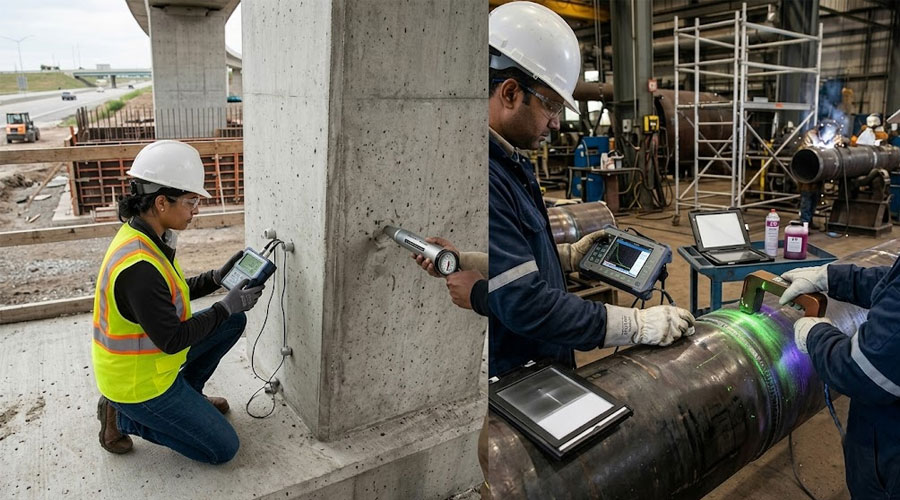
At Global Tech Quality Solutions, we provide professional Non-Destructive Testing (NDT) services to evaluate the quality, strength, integrity, and condition of civil structures and mechanical components without causing damage. Our testing services help identify hidden defects, assess structural performance, and support reliable inspection and maintenance decisions.
We offer specialized NDT solutions for civil structures and mechanical structures using proven testing methods and advanced inspection techniques.
Civil NDT by UPV and Rebound:
Our Civil NDT services are designed to assess the quality and condition of concrete structures without damaging the structure. We use Ultrasonic Pulse Velocity (UPV) and Rebound Hammer Testing to evaluate concrete quality, uniformity, and relative strength.
Ultrasonic Pulse Velocity (UPV) Test
UPV testing is used to assess the quality and uniformity of concrete by measuring the velocity of ultrasonic pulses passing through the structure. It can help identify areas of poor-quality concrete, cracks, voids, honeycombing, and other internal irregularities.
Rebound Hammer Test
Rebound Hammer testing provides an assessment of the surface hardness of concrete and an indication of its compressive strength. It is commonly used for evaluating existing concrete structures and identifying variations in concrete quality.
Mechanical Structure NDT ( UT/RT/MT/PT Method ):
We provide comprehensive NDT inspection services for mechanical structures, welded joints, fabricated components, pressure equipment, pipelines, and other critical components. These techniques help detect surface and internal discontinuities without affecting the usability of the component.
Ultrasonic Testing (UT)
UT uses high-frequency sound waves to detect internal discontinuities and measure material thickness. It is suitable for inspecting welds, plates, pipes, and other metal components.
Radiographic Testing (RT)
RT uses X-rays or gamma rays to examine the internal condition of welds and components. It helps identify internal defects such as porosity, inclusions, cracks, and lack of fusion.
Magnetic Particle Testing (MT)
MT is used to detect surface and near-surface discontinuities in ferromagnetic materials. It is particularly effective for identifying cracks and defects in welds and metal components.
Liquid Penetrant Testing (PT)
PT is a surface inspection technique used to detect small cracks, pores, and other surface-breaking defects. It can be applied to both ferrous and non-ferrous materials.
Our NDT Testing Process
Site Assessment
We understand the structure, component, material, and inspection requirements to determine the appropriate testing approach.
Method Selection
The most suitable NDT method—UPV, Rebound Hammer, UT, RT, MT, or PT—is selected based on the inspection requirements.
Testing & Evaluation
Our technical team conducts the inspection systematically and evaluates the test results to identify defects, discontinuities, or quality variations.
Reporting & Recommendations
A detailed test report is prepared with findings, observations, results, and recommendations for further action or maintenance.